
Employer healthcare spending in 2025: Why it’s likely to accelerate
The majority of the adult population continues to receive health coverage through an employer. In this post, we break down what to expect from employer healthcare spending in 2025.

At a glance
Read on to get our full commentary, or use the links below to jump to a specific area of interest:

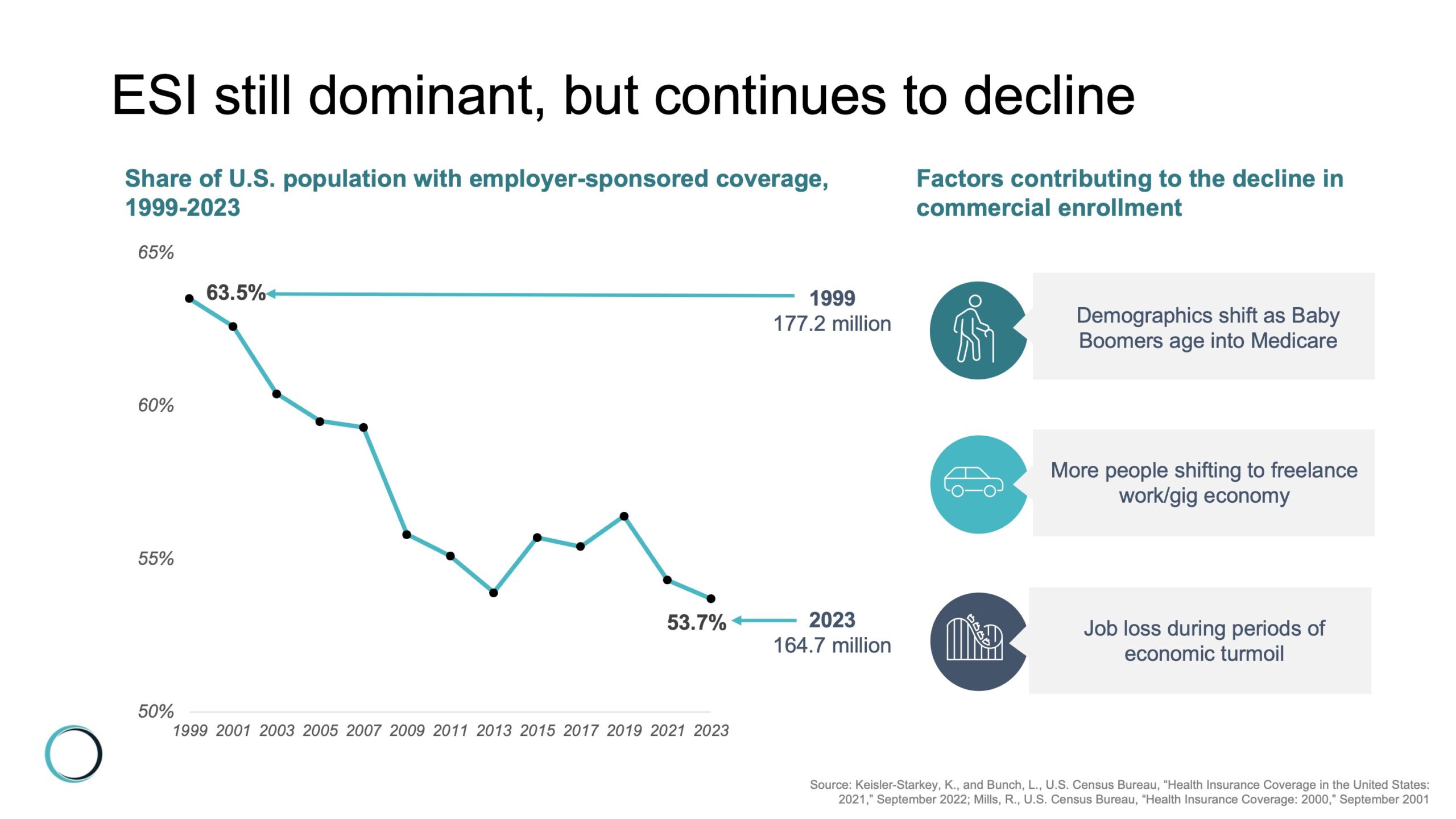
Although the share of Americans with employer-sponsored insurance has been declining for the past couple of decades, the majority of the adult population—54%, as of 2023—continues to receive health coverage through an employer. For that reason alone, we think it’s useful for healthcare leaders to stay on top of the latest trends in the ESI space: what’s changed, what hasn’t, and how employers are responding to their latest spending projections. The good news is, this is a corner of the industry that’s rife with data. Between the Kaiser Family Foundation, employer coalitions such as the Business Group on Health, and benefit consulting firms such as Mercer, PwC, and Willis Towers Watson, there’s a wealth of annually updated information out there. The hardest part is combing through it all to make sense of it, find consistent themes, and reconcile differences. The good news? We’ve done that work for you, and we had firsthand conversations with a number of employers to add some qualitative color. So in this post, we’ll break down what we learned, and what to expect from employer healthcare spending in 2025.
Employer healthcare spending in 2025: By the numbers

Union Healthcare Insight
Log in to continue reading
Not a member yet? Create a free account for limited access.

Let’s talk.
Questions? Want to learn more about what Union can do for you? We’d love to hear from you.
Related insights
The Great Utilization Shift

For-profit health systems’ financial performance in 2025—and what to expect in 2026

The national insurers’ financial performance in Q4 2025: How the Big Five insurers weathered 2025—and what to expect in 2026