Crossing the line: How many hospitals could lose 340B as Medicaid enrollment shrinks?

At a glance
Read on to get our full commentary, or use the links below to jump to a specific area of interest:

Read about our 340B analysis and then scroll down to the bottom of the blog post to use the interactive map.
Join our upcoming 340B fundamentals webinar
On Thursday December 17, join Amanda Berra and Steve Rowe for a “Boot Camp” on 340B Healthcare Fundamentals.
Click here to register: https://www.unionhealthcareinsight.com/events/how-to-speak-340b/
New year, new rules. Starting January 1, the 2025 federal budget law (H.R. 1) requires adults covered by Medicaid expansion, or a similar waiver, to prove 80 hours a month of work, study or volunteering unless they’re exempt, and to re-prove their eligibility every six months (more on the timing of this later.) The ripple effects of this law are expected to be broad, but the most talked-about impact is on coverage. The Urban Institute’s mid-scenario has 8 million fewer people on Medicaid expansion coverage in 2028, although the hit could be as high as 10 million. Safe to say many individuals and hospitals aren’t exactly feeling the love.
Why losing 340B would hurt
Obvious individual coverage issues aside, hospitals have another problem to contemplate: 340B. Since 1992, the program has required drugmakers that want Medicaid to cover their drugs to sell outpatient drugs at steep discounts to safety-net providers, so they can “stretch scarce Federal resources as far as possible.” Hospitals keep the gap between the discounted price and what insurers pay them, and that spread has become a major revenue source for health systems and a lifeline for many hospitals on narrow margins. To qualify, a nonprofit or public hospital has to prove it’s a safety net through a Medicare score called the DSH (disproportionate share hospital) percentage, which rises with the share of its inpatient days going to Medicaid and low-income Medicare patients. Fewer people on Medicaid means fewer Medicaid days and a lower score. Drop below the minimum and you’re out.
The 340B thresholds (to qualify)
- Above 11.75%: most general acute hospitals.
- 8% or more: rural referral centers (larger rural hospitals that take referrals from a wide area) and sole community hospitals (often the only hospital for a long distance).
- Each hospital qualifies on its own Medicare provider number, not as part of its health system.
Special cases
- A hospital registered at 11.75% that Medicare classes as a rural referral center or sole community hospital can re-register at 8%, but then loses 340B prices on drugs for rare diseases.
- Hospitals with a special state or local government funding status (shown as a flat 35% DSH percentage) pass the DSH test automatically.
Getting booted out would hurt financially. Hospitals bought about $87 billion of drugs at 340B prices in 2025, at discounts HRSA puts at 25% to 50%. Lose 340B eligibility and that discount is gone. And there’s little fat to cut: the median health system operating margin was -0.6% in January 2026 and just 0.7% by June (Strata Decision Technology, more than 2,200 hospitals). For many safety-net hospitals, 340B is what keeps the lights on. In a 2021 340B Health survey, nearly three-quarters of rural 340B hospitals said the savings helped them stay open.
This is happening against a backdrop of two federal changes that are slated to kick off on January 1, 2027:
- HRSA’s revised 340B rebate pilot: drugmakers HRSA has approved can swap the upfront 340B discount for a rebate paid after the sale, on drugs picked for Medicare price negotiation. It doesn’t change who qualifies for 340B or how much hospitals get paid for 340B drugs, but it ties up cash and adds paperwork.
- 2027 Outpatient Prospective Payment System (OPPS) rule: Medicare will pay most hospitals a drug’s average sales price (ASP) minus 28% for outpatient drugs bought at 340B prices, down from ASP plus 6% (drugs bought at full price stay at ASP plus 6%). That makes 340B worth less on traditional Medicare patients, but also makes the loss on them smaller for a hospital that drops out.
So, how many hospitals could lose 340B?
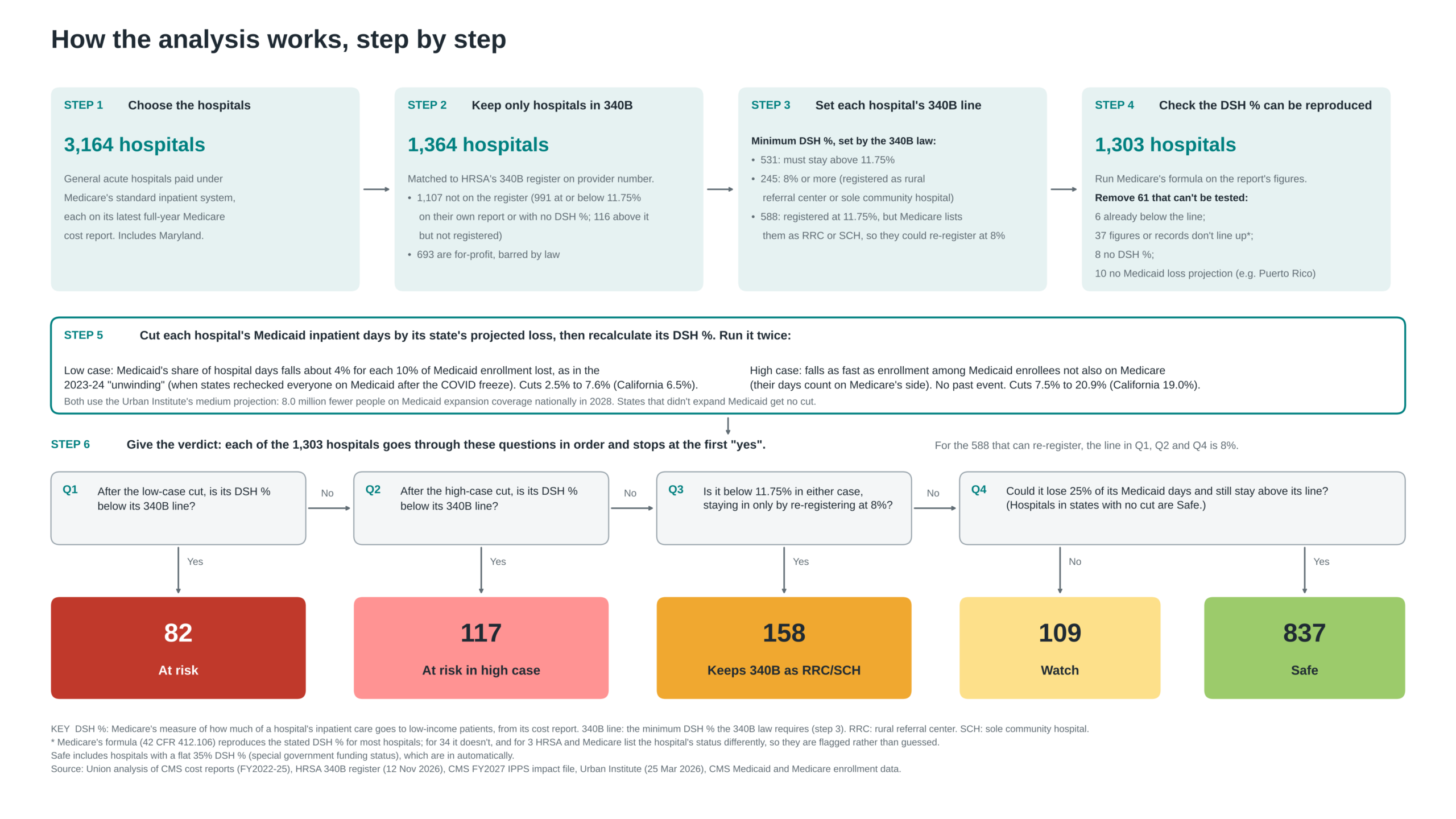
We had a crack at a guesstimate. For our “swag”, we matched the latest Medicare cost report for every general acute hospital on Medicare’s standard inpatient payment system (plus Maryland’s hospitals) to the federal 340B register as of November 12, 2026. That gave us 3,164 hospitals, 1,364 of them in 340B. The other 1,333 340B hospitals aren’t in our count: most are critical access hospitals (small rural hospitals with 25 beds or fewer), which don’t face a DSH test, and nearly all the rest are children’s and cancer hospitals whose cost reports don’t have the numbers we needed. After setting aside hospitals with missing data or a DSH percentage we couldn’t reproduce, we had 1,303 to test. For each, we cut its Medicaid inpatient days in line with its state’s projected enrollment loss, recalculated its DSH percentage and checked it against its minimum.
A low case and a high case
The big unknown is how far a hospital’s Medicaid days fall when enrollment falls. So, we ran two scenarios: one based on what happened during the 2023-24 Medicaid unwinding (the low case) and one harsher assumption (the high case).
How we tested: the low case and the high case
- Low case (0.4 to 1): Medicaid days fall the way they did during the 2023-24 unwinding, when states rechecked everyone on Medicaid after the COVID-era freeze on removals ended and dropped more than 25 million people. Back then, in expansion states, every 10% drop in enrollment cut Medicaid’s share of hospital days by about 4% (cost reports from 2,447 hospitals).
- High case (1 to 1): Medicaid days fall as fast as enrollment, with nothing to soften the blow. We leave out people on both Medicaid and Medicare, since their hospital days already count on Medicare’s side of the DSH score.
Limitations of the analysis
Like any analysis, ours has its limits.
- This is new territory. Work requirements have never run nationally, so we’re in uncharted waters.
- Projections are limited to using state-level estimates of impact. Currently available Medicaid loss projections exist only at state level, so every hospital in a state gets a similar cut, and real life won’t be that tidy.
- Shorter retroactive coverage isn’t modeled. Medicaid has been able to cover hospital bills from up to three months before someone signed up. Starting in 2027, H.R. 1 cuts that to one month for expansion adults and two months for everyone else, so fewer hospital days will count as Medicaid. Neither case allows for this, so both may understate the hit.
- Some figures could still change. About 99% of the 340B hospitals are rated on cost reports Medicare hasn’t settled yet (almost all for financial years ending in 2025).
- We assess risk, but don’t put a dollar amount to it. We only “guesstimate” which hospitals are most exposed. We can’t put a dollar figure on each, because no national data shows how much any hospital saves through 340B. A handful of states have started collecting it, with Minnesota furthest along, but coverage is patchy.
What we found
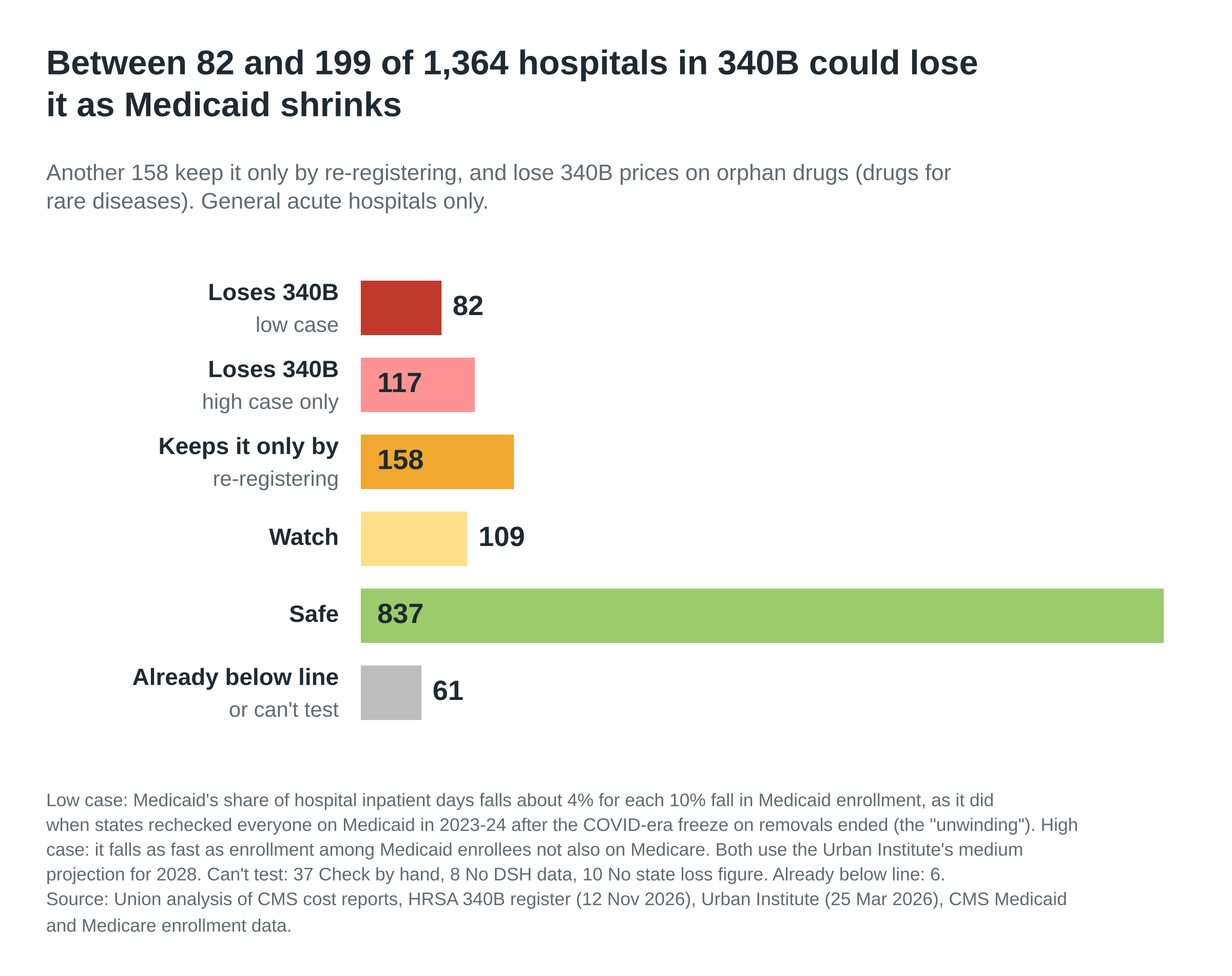
Of the 1,303 hospitals we tested, between 82 and 199 (roughly 6% to 15%) would fall below their DSH threshold, meaning they could lose 340B. Another 158 could hang on, but only by re-registering at 8%, which means losing 340B prices on orphan drugs when they’re used for the rare diseases they’re designated for.
Click image to see overall risk profile (opens in new tab)
A couple of other things to note:
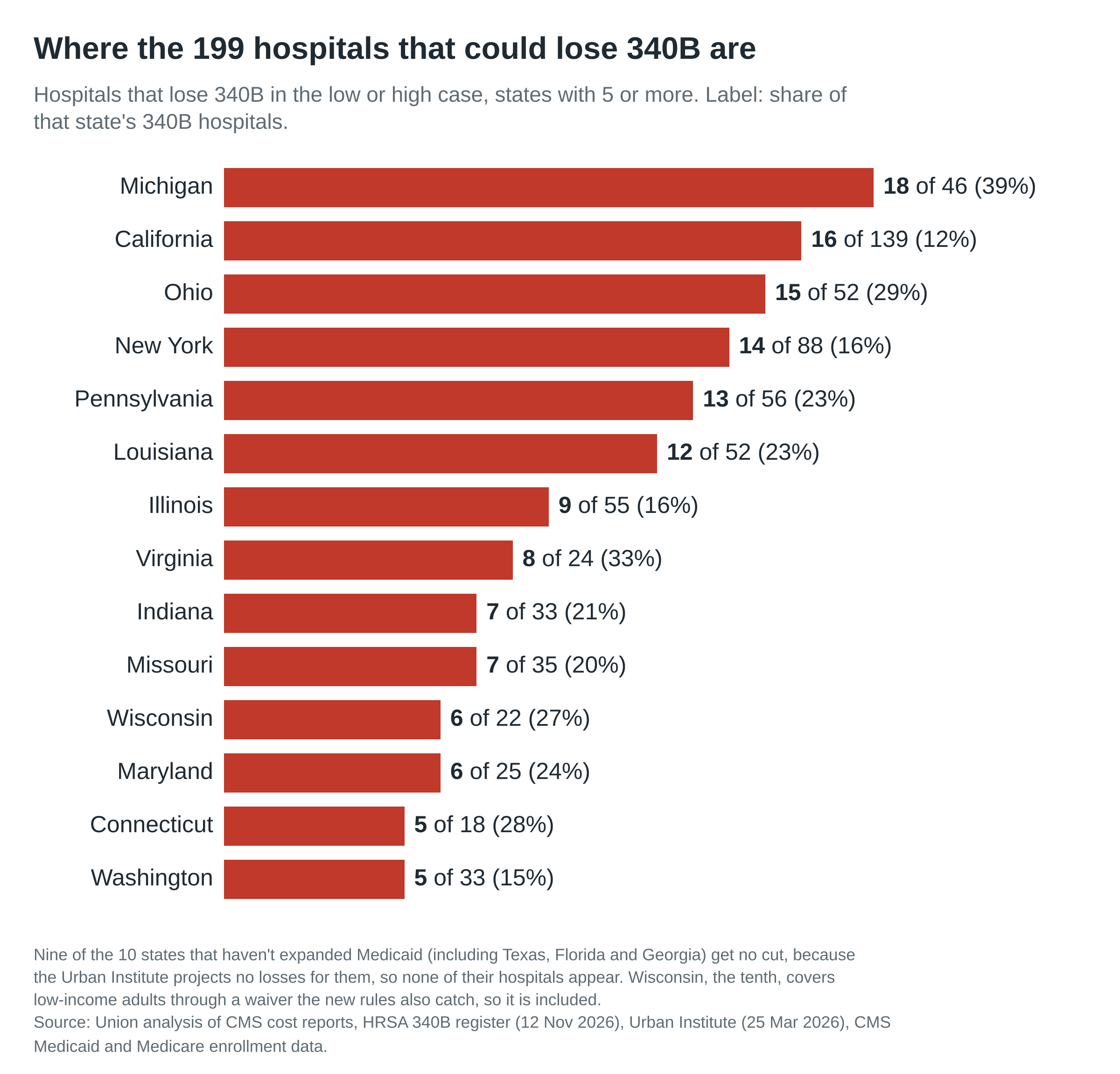
- Closeness to the line matters more than the size of a state’s cut. Michigan has the most hospitals at risk (18 of 46) on our estimate of a 13% fall in enrollment, smaller than California’s 16%.
- Exits will be slow. A hospital drops out the day it files a cost report that puts it below its minimum, and it only files once a year. Most exits would show up in reports filed from 2028 onward (more on timing below).
So how much should we trust this? We checked it against history. The 2023-24 Medicaid unwinding is a good stress test. We took each hospital’s cost report from just before the unwinding, applied its state’s actual enrollment drop, and checked who left 340B or had to re-register over the next two years. Among hospitals with the least cushion (less than 10% of their Medicaid days to spare), about 1 in 6 left or re-registered, against about 1 in 100 of those with the most room (25% or more). So, the model ranks risk well, but it’s no crystal ball: of the 54 hospitals it flagged as at risk in the low case, 14 (about 1 in 4) left or re-registered, and some that left weren’t flagged at all. Treat our results as a ranked shortlist, not a prediction. Most of the 82 are already close to the line (40 sit within a quarter of a percentage point of it today), so ordinary year-to-year swings could tip some over, or back, with or without the Medicaid cuts.
Click image to see states with most hospitals with higher risk profile (opens in new tab)
What this means for hospitals and health systems
What to do about it. 340B eligibility is decided hospital by hospital, so one hospital in a system can lose it while another keeps it. For each hospital, ask what share of its Medicaid days it could lose before dropping below its threshold. If the answer is under 25%:
- Track its DSH percentage through the year.
- Work out what losing 340B would do to its finances.
- Get every eligible Medicaid day onto the cost report. HRSA may accept an amended report, but it won’t restore eligibility after the fact.
Some states get no cut. Nine of the 10 states that haven’t expanded Medicaid get no cut here, because the Urban Institute projects no enrollment losses for them. Wisconsin, the tenth, covers low-income adults through a waiver the new rules also catch, so it’s included. In these states, “Safe” on the map means safe from the cuts we model, not safe full stop: 45 hospitals there would drop below their line if their Medicaid days fell by less than 10%, and the shorter retroactive coverage we don’t model applies to them too.
Plenty is still unknown. Three things will decide whether reality lands closer to our low or high case:
- How much each state automates eligibility checks rather than relying on paperwork.
- Whether the people who lose coverage are sicker, and so use more hospital days, than in 2023-24.
- Whether CMS grants states longer delays, which the law allows up to the end of 2028.
A late-breaking reprieve could change the timing
True to Murphy’s law, as we were finishing this analysis, CMS’s top Medicaid official, Dan Brillman, told states on November 13 that they can pause the work requirement until as late as June 30, 2027. States still check who meets it, but no one gets turned away or kicked off for failing it. States wanting the pause from January 1 must notify CMS by December 11.
That could push back when hospitals lose 340B. A hospital loses eligibility the day it files a cost report showing its DSH percentage below the line, and reports are due five months after the financial year ends. Take a hospital whose year matches the calendar: its 2027 report is due by May 31, 2028. In a state that takes the full pause, that report captures only six months of work-requirement removals (July to December 2027), so the hospital may scrape through. But it’s not off the hook. Its next test is the full 2028 report, due by May 31, 2029, by which time there’s a new administration and anything could happen.
Data sources and references
- Union Healthcare Insight analysis of CMS Medicare cost reports (Hospital Form 2552-10, FY2022 to FY2025 files) and the HRSA 340B Covered Entity Daily Report, November 12, 2026.
- Urban Institute with the Robert Wood Johnson Foundation (Buettgens, Karpman, Haley, Carter and Kenney), Projected Reductions in Medicaid Expansion Enrollment Under OBBBA’s Work Requirements and Six-Month Redeterminations: National and State Estimates for 2028, March 25, 2026.
- CMS Medicaid and CHIP Performance Indicator data, March 2026 release (state Medicaid enrollment).
- CMS Medicare Monthly Enrollment, July 2024 to June 2025 (people on Medicare who also get full Medicaid benefits, by state).
- HRSA, 2025 340B Covered Entity Purchases.
- Strata Decision Technology, Performance Trends Report, first half 2026, as reported by HFMA.
- KFF, As Medicaid Unwinding Concludes in Most States, KFF Finds 25 Million Lost Medicaid Coverage but Enrollment is 10 Million Higher Than Pre-Pandemic Levels, press release, September 18, 2024.
- Public Health Service Act §340B(a)(4), 42 U.S.C. 256b; 42 CFR 412.106.
- CMS, SMD# 26-006, Optional Hold Harmless Period for Community Engagement Implementation, November 13, 2026.
- HRSA, 340B Program FAQ: Does HRSA accept amended Medicare Cost Reports and can they be applied retroactively?
- H.R. 1 (Public Law 119-21) §71112, retroactive Medicaid coverage.
- CMS, CY2027 Hospital Outpatient Prospective Payment System final rule, Federal Register document 2026-22739.
- CMS, FY2027 IPPS Impact File.
- HRSA, Notice Regarding 340B Rebate Model Pilot Program, 91 FR 48,883, August 3, 2026.

Let’s talk.
Questions? Want to learn more about what Union can do for you? We’d love to hear from you.
Related insights
This week in healthcare: 340B winners and losers, No Surprises Act, and employee healthcare costs going up (again…)
What the 2026 midterm election results mean for healthcare policy

The new patient financial reality