
Down on the Upside? Unpacking the current state of vertical consolidation

For years, vertical consolidation has been a mainstay of the insurer playbook—blending payer, provider, pharmacy, and PBM assets into a single, integrated ecosystem designed to drive synergies, provide consistent margin performance, and withstand turbulence to any one part of the business. It’s a strategy that worked remarkably well through the 2010s and early 2020s.
We may be reaching a turning point. Recent financial results across all national players —but especially from long-time market leader UnitedHealth Group—suggest that the flywheel of integration is spinning a bit off balance. The industry is experiencing a series of escalating structural pressures that are not expected to fade anytime soon. Nor are they pressures that the industry can simply wait out or push back against by protecting existing profit centers. Which brings us to our main question for exploration: Are insurers reaching the limits of vertical consolidation as a strategy?
Current state of health insurer consolidation
Every major national insurer now operates as a healthcare conglomerate, stretching far beyond traditional health plan functions. Vertical consolidation is not a new trend—insurers have been working to acquire or merge with profitable assets along the health care value chain for years.
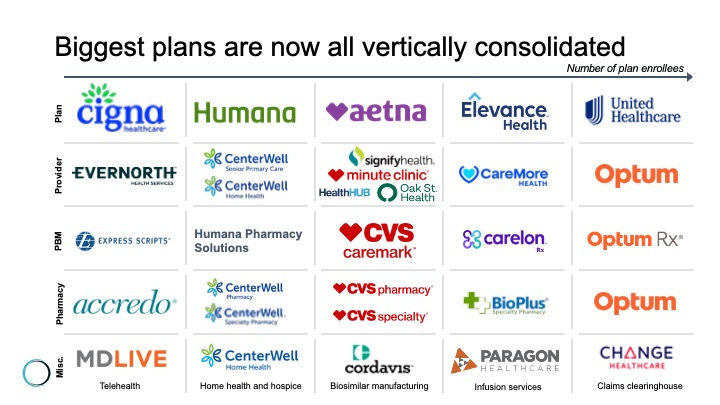
The strategic logic has been: integrate along the value chain to capture margin leakage and smooth volatility. When reimbursement tightens in one segment, profits from another can fill the gap. This strategy also makes insurers less purely dependent on their medical loss ratio (MLR) performance. Yes, MLR is still a key financial metric for insurers, but the conglomerate can still achieve profitable quarterly earnings, even when its MLR takes a hit.
The effectiveness of the current state of vertical consolidation depends on counter-cyclical performance (i.e. the pressures that challenge one corner of the industry simultaneously offer a lift to another). But today, the pressures facing the industry are not the typical cyclical pressures that we’ve seen in the past. Headwinds are aligning across multiple segments simultaneously: rising utilization, changes to MA reimbursement, pharmacy cost inflation, and regulatory crackdowns on PBMs are hitting all major components. In other words, the counter-cyclical model that powered vertical consolidation is not holding up as well as it once did. We’re seeing that play out in high MLRs across the board.

UnitedHealth: A “canary in the coal mine”?
UnitedHealth Group (UHG) was the original case study in how vertical consolidation. By some estimates, “internal” transactions equate to as much as 40% of UHG's revenue (when such transactions are included), suggesting that the company has built a series of effective flywheels that allow various business units to feed into one other. One publicly reported example is the relationship between OptumRx (the company's PBM) and UnitedHealthcare (the health insurance asset). The share of UHC enrollees using Optum RX has grown over time, as has the share of Optum RX’s revenues that are generated by UHC enrollees. In fact, UHC enrollees now account for a majority of OptumRx's business.
But despite its history of effective vertical consolidation, UHG had a rough start to 2025. Following unexpectedly high medical costs—especially in Medicare Advantage (MA)—the company slashed profit forecasts in the first quarter and saw its share price slashed in half. Even after a series of course corrections, its MLR remained elevated at 89.9% in the third quarter (up slightly from its already abysmal 89.4% in Q2). These troubles reflected UHG’s inability to quickly recover from a series of MA miscalculations (more than half of UnitedHealth’s higher-than-expected costs were attributed to the Medicare portfolio).

UHG’s third-quarter performance was nevertheless up slightly but meaningfully, with decent revenue and earning growth that beat expectations. But it’s worth noting that UHG’s Q3 performance was fueled by growth in its Optum Rx (i.e. PBM) business, and the beginning of repricing in its United Healthcare insurance business (we should note that many of United's MLR troubles have been related to its generally favorable premium prices for employers and consumers, so price hikes were always going to be part of any recovery). Optum Rx saw 16% year-over-year revenue growth, largely driven by growth in prescription volume and pharmacy services. But just like MA was a major tension point for UnitedHealth in the first half of the year, we expect PBMs to act as a tension point over the next few years (we’ll cover why that’s the case in the next section). Bottom line: UHG’s performance was stressed by MA in the first half of the year and now appears to be stabilizing largely due to its PBM business—but we’re still seeing evidence that there are cracks in the vertical consolidation model.
Cracks across the current state of vertical consolidation
If you’ve followed our posts, you’ll recall that over a year ago we predicted that insurers would eventually be forced to reconsider their vertical consolidation model as they faced inevitable pressures that would reduce its effectiveness over time. And we’re seeing this play out now. Just look at UHG—its performance has been largely dictated by its MA and PBM businesses, two areas that are facing direct regulatory scrutiny and putting pressure on the vertical consolidation model. We’re seeing similar stories pay out to some degree across all the major insurers. Let’s unpack some of the forces, including MA and PBMs, that are challenging the vertical consolidation model.
Medicare Advantage: Once a profit engine, now a pressure point
For well over a decade, MA was considered an industry cash cow, with consistently higher gross margins than all other segments of the health insurance business. Not only was it profitable, but the favorable demographics also turned it into a significant growth engine, particularly for insurers with heavy MA footprints, like Humana and UnitedHealth. There were a few factors driving the high profitability:
Rapid growth in the program: MA enrollment grew steadily over the past decade, and now, over half of all Medicare beneficiaries are enrolled in MA—ensuring a steady revenue stream and economies of scale. (Note: MA enrollment growth has slowed recently. We’ll be watching to see if the enrollment slowdown is here to stay or simply a blip on the radar as some have suggested.)
Insurers’ ability to maximize payments that drive profit: Insurers have numerous strategies to enroll healthier individuals while also “optimizing” risk scores (through comprehensive coding and documentation) to receive higher reimbursement for MA enrollees. As a result, Medicare pays private MA plans more than it would typically spend on enrollees in traditional Medicare, sometimes up to 123% of comparable fee-for-service costs. The higher reimbursement translates to higher profits: insurers reported gross margins per enrollee of $1,982 in Medicare Advantage in 2023, roughly double that of gross margins in the individual and employer group insurance markets.
But more recently, reimbursement pressures and legal challenges around star rating methodologies and documentation requirements have introduced new financial pressures and made the MA outlook more uncertain:

Changes to the MA plan star ratings methodology: Star ratings are a critical performance measurement tool for MA plans as the rating directly influences payment rates and, consequently, profitability. To briefly explain how it works, CMS rates MA plans annually on a scale of one to five stars across a series of metrics including customer service, preventive care, chronic disease management, and member satisfaction. A higher score (four stars or above) invariably translates to bonus payments and additional rebates which can help feed into enrollment-growth levers such as premium reductions and the ability to offer more supplemental services. The 2025 MA star ratings introduced several methodological revisions (see above image for more details) that, while seemingly technical, have made it harder for insurers to achieve high scores, reducing bonus payments and prompting legal challenges from major payers like UnitedHealth, Elevance Health, and Humana—with mixed results.

Hierarchical Condition Category (HCC) Version 28 (v28): Risk adjustment is a critical component in determining payment to MA plans. CMS groups diagnosis codes into hierarchies based on similar profiles and expected costs, called HCCs, which are used to determine risk scores. Again, a higher risk score translates to higher payments. HCC v28 (commonly referred to as just “v28”) is the most significant change to MA risk adjustment in a decade. V28—which will be fully phased in by 2026—reshapes how patient risk, and therefore plan revenue, is calculated. Insurers are concerned that the changes will underestimate patients’ risk cores and lead to less funding. In fact, we’ve already seen many insurers attribute rising MLRs to challenges adapting to v28.
These MA-related pressures have prompted some plans to restrict or exit unprofitable MA markets across 2024 and early 2025. (We’ve also seen an uptick in hospitals and health systems opting to end or not renew contracts with some MA plans over administrative challenges). Those who exited unprofitable MA markets earlier were shielded from some of the pressures that hit UnitedHealth—who was holding on until Q2 2025 when it announced it would also exit some MA markets. And now, earlier this month, CVS Health, Elevance Health, Humana, and UnitedHealth all announced plans to further scale back MA plans in 2026.
Provider assets—especially brick-and-mortar—are under margin strain
Integrated primary and specialty care assets—once envisioned as the cost-control hubs for insurer ecosystems—are also under pressure, due to MA headwinds and rising care costs. Starting in the mid-2010s, national insurers steadily expanded into the primary care sector with the goal of strengthening their MA positions and improving care coordination. In fact, as of 2023, more than 6% of primary care physicians and other clinicians billing Medicare were working for a payer-operated practice. But of course, now MA is more of a tension point than an opportunity.
The struggles in primary care extend to the retail space as well. Last year, we wrote a blog post covering that many major players—including insurers—were divesting or scaling back primary care services, especially retail care. The “Great Retail Retrenchment” continues as organizations such as CVS Health scale back underperforming clinics. It’s not that insurers are abandoning care delivery—they definitely aren’t. But they are shifting to optimization over expansion: consolidating sites, digitizing workflows, and integrating more AI-driven population health tools rather than building new bricks-and-mortar capacity.
In sum, provider assets are a mixed bag—at least in terms of their impact on bottom lines. For some insurers, such as Humana, primary care has continued to grow and contribute to financial performance by improving care coordination and increasing patient volumes. On the other hand, insurers have faced challenges with increased utilization and medical costs tied to these integrated services. The investments in primary care aim to manage risk and costs long-term, but near-term financial results remain vulnerable to high medical costs and regulatory pressures.
PBMs and pharmacy: From profit lever to policy target
As insurers have struggled in their insurance and provider segments, many have relied on their drug and pharmacy sectors, including PBMs, to buoy overall performance.
PBMs are a frequently cited but poorly understood part of healthcare. So, if you’re not familiar, PBMs are companies that act as intermediaries between health insurers or employers and pharmacies to manage prescription drug benefits. Their main role is (according to them) to help control the cost of prescription drugs and make medications more affordable and accessible for patients (there are mixed reviews on how well they’re accomplishing those objectives). Today, PBMs have become increasingly tightly integrated with health insurers, with the largest insurers owning PBMs or being part of companies that own PBMs: in 2024, over 80% of all equivalent prescription claims were processed by three companies—CVS Caremark (CVS Health), Express Scripts (Cigna), and Optum Rx (UHG). Collectively, these three companies’ PBM profits increased 438% over ten years, from $6.3 billion in 2012 to $27.6 billion in 2022.

But now, PBMs are facing significantly more regulatory (and public) scrutiny as PBM consolidation and insurer ownership provoke concerns about anti-competitive behavior, with calls for more oversight on PBM pricing practices and rebate structures:
Increased transparency requirements: The heavily concentrated nature of PBMs leads to greater market power and reduced competition. In theory, increased transparency would help promote competition and reduce excessive profits—it still remains to be seen how effective federal and states efforts will be in achieving this aim. Bipartisan bills such as the PBM Reform Act of 2025 (H.R. 4317)—endorsed by the AMA—seek to introduce further transparency and fairness rules at the federal level. At the state-level, multiple mandates would require PBMs to report rebates, spread pricing, administrative fees, and formulary data to increase the transparency of insurer-owned PBM operations and pressures insurers to justify costs and rebate practices more transparently.
Restrictions on pricing practices: In general, there’s bipartisan skepticism around PBM-approaches drug pricing, specifically that rebates and spread pricing may actually inflate drug prices. Recent proposals would require PBMs to pass all rebates along to the ultimate payer and would limit or ban “spread pricing” (i.e. the difference between what the PBM charges the plan/employer for prescription drugs and what the PBM reimburses the pharmacy—the PBM keeps the difference as profit). Advocates hope that this step would save money for payers (i.e. insurers or employers) by reducing the prices they pay for drugs to the lower prices that PBMs pay pharmacies.
Limitations on vertical consolidation: With many PBMs now tightly integrated into insurers, critics are increasingly raising concerns about anti-competitive practices. For example, insurers with their own PBMs could charge rivals without PBMs higher prices for their PBM services. Or PBMs could steer business to their own pharmacies, or reimburse pharmacies at below-cost rates, which may ultimately drive other pharmacies out of the market. In response to these concerns, we're seeing state legislation and pending federal discussions seek to prohibit or restrict PBMs from owning pharmacies or other conflicts of interest. In April, Arkansas passed a law that prohibits PBMs from owning or holding permits for retail or mail-order pharmacies starting January 1, 2026. This law could have nation-wide effects as it will change how prescription drug benefits are managed and means PBMs would need to divest pharmacy interests. Downstream, the law could reduce the economic benefit of PBMs, potentially leading to insurers restructuring their PBM services.
Retail pharmacy on the decline while specialty pharmacy remains a bright spot
Pharmacy divisions are experiencing two very different realities right now: pharmacy volumes and revenue are growing, but profitability is being squeezed by reimbursement pressure, specialty drug costs, and the ongoing reconfiguration of store formats and distribution networks. On one hand, retail pharmacy is struggling. It’s been on the decline for a while now, and that hasn’t changed in 2025 as retail sales remain weak. We’ve seen conglomerates like CVS Health close underperforming stores to focus on pharmacy‑centric, digitally enabled formats. On the other hand, specialty pharmacy has been a strong point for many insurers across the year. We saw better-than-the-pack performance from insurers with a focus on specialty pharmacy services, like Cigna and CVS Health. And remember, UHG’s Q3 performance was boosted by its performance in its pharmacy segments as well.

Overall takeaway: The conglomerate model is faltering
Vertical consolidation is a challenging strategy to pull off in healthcare, and now, even the biggest players are being directly pressured by strong headwinds across the industry as the once “golden goose” elements of these businesses (notably MA and PBMs) are facing direct regulatory scrutiny. It’s likely that UnitedHealth’s experience earlier this year wasn’t an aberration. There’s a strong case that the conglomerate model is faltering. With that in mind, the big conglomerates have three options:
Batten down and wait out the storm: To a real extent, their troubles stem from so many challenges to core business happening at once. While many of these challenges are structural—and aren’t going away any time soon—it’s not always going to be the case that they will impact profitability simultaneously. In the short-term, the conglomerates could protect profit centers till the storm passes, then deal with structural issues one by one. (This seems to be the approach that UnitedHealth has taken to turn its performance around in the second half of the year.)
Take a back-to-basics approach: Conglomerates could also consider shedding businesses that are underperforming and boost those that are growing. However, the willingness to do so will vary with corporate cultures.
Integrate to ignite discontinuous growth and cut costs: Most of the big conglomerates say that this is their ultimate aim, but it’s also the most difficult strategy—and there’s not much evidence that any of them can pull this off.
That’s a long way of saying that we will likely see moves to protect profit centers, divest where possible, and integrate where opportunities arrive—which is almost certainly what all of insurers will be doing.
Want more on this topic?
This is one of the topics we’ll discuss at our in-person East Coast Insight Summit in November. Members can learn more about the summit and submit a registration request on the event's landing page.
Not a member? Schedule time with us to learn more about how to join, and what's included in membership: https://www.unionhealthcareinsight.com/overview.


